Home

GEF Logo

GEF Logo

Search
  • Who We Are

    Organization

    • Overview
    • Focal Points
    • Secretariat Staff
    • Interim CEO

    GEF Council

    • Members & Alternates
    • Work Programs
    • Meetings
    • Decisions

    Funding

    • Overview
    • GEF-9
    • GEF-8
    • GEF-7
    • Replenishment Documents
    • Overview
    • Focal Points
    • Secretariat Staff
    • Interim CEO
  • What We Do

    Topics

    Topics

    • Amazon
    • Biodiversity
    • Blended Finance
    • Food Security
    • Forests
    • Global Biodiversity Framework Fund
    • Illegal Wildlife Trade
    • Integrated Programs
    • International Waters
    • Land Degradation
    • LDCF
    • Mercury
    • Plastics
    • Pollution
    • SCCF
    • Sustainable Cities
    • Transparency
    • View All Topics >>

    Stakeholder Engagement

    Stakeholder Engagement

    • Civil Society
    • Country Engagement Strategy
    • Fonseca Leadership Program
    • GEF Voices
    • Indigenous Peoples
    • Knowledge & Learning
    • Private Sector
    • Youth
  • Projects & Operations

    Projects

    Projects

    • Project Database
    • Templates
    • How Projects Work

    Countries

    Countries

    • Recipient Countries
    • Donor Countries
    • Participant Countries
    • Country Engagement Strategy

    Operations

    Operations

    • Conflict Resolution Commissioner
    • GEF Geospatial Platform
    • Knowledge & Learning
    • Policies and Guidelines
    • Results
  • Partners

    Partners

    • Countries
    • GEF Agencies
    • Conventions
    • Civil Society Organizations
    • Private Sector
    • Countries
    • GEF Agencies
    • Conventions
    • Civil Society Organizations
    • Private Sector
  • Newsroom

    Newsroom Menu Column 1

    • All
    • News
    • Feature Stories
    • Press Releases
    • Multimedia
    • Publications
    • Blog
    • Partner News

    Newsroom Menu Column 2

    • GEF Logo
    • Newsletter
    • Media Contacts
    • All
    • News
    • Feature Stories
    • Press Releases
    • Multimedia
    • Publications
    • Blog
    • Partner News
  • Events
  • Search

LDCF - Rwanda - Reducing Vulnerability to Climate Change by Establishing Early Warning and Disaster Preparedness Systems and Support for Integrated Watershed Management in Flood Prone Areas (Video available)

News
February 23, 2010
Untitled_2_6.jpg
Untitled_2_6.jpg

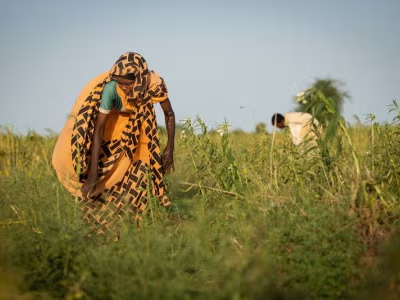
The LDCF project “Reducing Vulnerability to Climate Change by Establishing Early Warning and Disaster Preparedness Systems and Support for Integrated Watershed Management in flood prone areas” is helping 10 districts in Rwanda address their diverse adaptation needs, in partnership with UNEP, UNDP, RAB (Rwanda Agriculture Board), and AAP (African Adaptation Program).

Ninety-percent of the population in Rwanda depends on subsistence agriculture, which is the sector that is most affected by the impacts of climate change. The project’s main objective is to reduce the vulnerability of the Gishwati ecosystem and its associated Nile-Congo watersheds, and the people that derive their livelihoods from it, to increased floods and droughts due to climate change.

In 2007, Rwanda completed its NAPA (National Adaptation Program of Action) in which the following climate threats were highlighted: flooding, landslides, heavy rain falls, extreme temperatures, heat waves, and drought. These phenomena have translated into low agriculture productivity, water shortage, and low agricultural output. In order to face these challenges, the Rwanda Environment Management Authority, with LDCF funding and UNEP execution selected the districts of Nyabihu. Ngororero, Rubavu, Rutsiro, Nyamagabe, Bugesera, Kayonza, Gatsibo, Kirche and Rulindo, to pilot adaptation measures.

LDCF financed activities are assisted by technical services of the RAB in order to not only enhance agricultural productivity, improved water distribution and management, but also, ensure economic incentives for the local people. The project is helping local farmers and pastoralists improve their crops and get access to water for their livestock, in order to safeguard their livelihoods.

Adaptation activities are diverse in nature, depending on the pilot sites (districts). Some of these include: activities to lessen soil erosion impacts, growing of fruits, conservation of river banks, plant water-entrapment trees, raise awareness, mix trees with selected crops to stop soil from washing away to ensure food security while boosting the economy, build crop greeneries, irrigation projects for farmers, and forest and land rejuvenation. These activities are to happen in a span of 2 to 4 years, and will be completed by 2014. 

Topics

Climate Change
Climate Change
Climate Change Adaptation

Related News

Multimedia

40th LDCF and SCCF Council back new projects and 2030 strategy

June 2, 2026
Multimedia

LDCF & SCCF: Building resilience where it's needed most

June 2, 2026
African woman farmer in a field
News

GEF adaptation funds back new projects and 2030 strategy

June 2, 2026

GEF Updates

Subscribe to our distribution list to receive the GEF Newsletter.

Sign up

GEF Logo

Follow Us

GEF Affiliated Sites

  • GEF Portal
  • Independent Evaluation Office
  • Scientific and Technical Advisory Panel
  • Small Grants Program

Who We Are

  • GEF Secretariat Staff
  • Conflict Resolution Commissioner
  • Council Members & Alternates
  • Focal Points
  • Careers
  • Legal
  • Contact Us

© 2026 Global Environment Facility, All Rights Reserved.  |   Legal