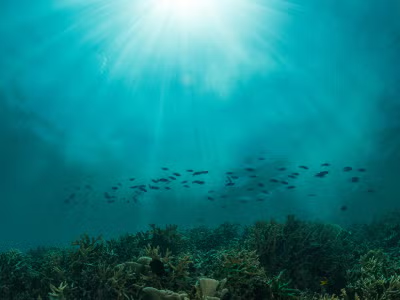

Malaysia Wetland_text.jpg
If there were a natural solution to flooding, soil erosion and water contamination, wouldn’t it be worth protecting?
The world’s wetlands may well be that solution.
From the Mesoamerican reef, to the Guaraní aquifer and the vast Pantanal, to the Vinciguerra glacier in the very south of the region, Latin America is not only awash with water but also the wetlands which such reserves create.
Worldwide, wetland areas cover a vast 13 million square kilometres, a land area equivalent to the combined land mass of Argentina, Brazil, Bolivia, Chile, Ecuador, Paraguay and Uruguay, and generate an estimated annual value of US$70 billion in ecosystem services.
“Wetlands are extremely important,” explains Christian Holde Severin, Senior Environmental Specialist at the GEF, “and in a changing climate they are becoming even more so. They are an essential part of the infrastructure in both cities and natural ecosystems.”
According to the WWF, between 300 and 400 million people worldwide live close to – and depend on – wetlands for the vital services they provide the surrounding area, including protection against:
- flooding
- soil erosion and land degradation
- loss of biodiversity
- contamination of freshwater sources
- tidal surges, waves and storms (in coastal areas)
However, despite these benefits, the world’s wetlands are under threat. Agricultural practices, deforestation, dams, dredging and urban development have led to the global loss of close to two-thirds of coastal and freshwater wetlands since 1900.
Urbanisation
Latin America is one of the most urbanised regions in the world, with almost 80% living in cities. As the population increases, so do the demands on the urban environment and the surrounding ecosystems.
“We need to develop and sustain growing cities, by integrating wetlands and the many services they provide, into modern urban planning,” Severin notes. “We have tried to contain rivers with concrete, but we now understand that this doesn’t work. Therefore, we need to ensure healthy riverbanks and associated floodplains are maintained, as these wetlands have the essential capability of absorbing excess water. Time and again, we have experienced what happens, when this natural buffering capacity is not there. In a world with a changing climate and high fluctuations in precipitation, the buffering capacity is more important than ever to avoid flooding and the associated costs.
It’s a situation that has been seen time and again in the Dominican Republic. Here, a lack of knowledge about floodplains, and no enforced zones means many poor communities live along the banks of the Ozama River in Santo Domingo. It’s a precarious location, and consequently they are highly vulnerable to flooding – a situation which will only get worse as precipitation patterns are changing
Coastal wetlands, such as marshes, mangroves etc. often giveway to urban development or coastal tourism, as their true value is often not realised when local and national development plans are approved. Being able to estimate the monetary value of the short and long term services which wetlands provide, will be an important step in securing wetlands for today’s growing population and for the estimated 9 billion people in 2050.
Agriculture and Wetland Interactions
Healthy wetland ecosystems situated between the freshwater and agricultural zones offer a buffer to combat the effect of the run off, preventing both nutrients and sediment from making it into the water network. Land degradation already affects 300 million hectares of agricultural land in Latin America as deforestation and lack of vegetation cover leaves valuable topsoil vulnerable to being washed away by rainfall.
“Wetlands act both as a corridor for biodiversity and as a means of protecting the freshwater. The vegetation captures agricultural fertilizers and valuable topsoil that would otherwise be washed downstream,” highlights Severin.
This is particularly evident in the vast Pantanal, which sprawls across 3 nations: Brazil, Paraguay and Bolivia.
Home to thousands of bird, plant, fish and reptile species, the rivers and marshes of the Pantanal are considered to be one of the best conserved wetlands in the world. But even here, the effects of human incursion in the area are being felt. Nearly 60% of the upstream headwater areas have been deforested for cattle ranching and soy production, causing soil erosion and affecting the quality of the water in the region.
Raising awareness
While currently fairly low-profile on the global agenda, wetlands are of huge global importance.
Capable of absorbing significant amounts of stress, they provide rivers with their freshwater, protect it for human consumption and secure key habitats for fish, birds and other biodiversity. What’s more, as Severin highlights, they offer the tools to address other environmental threats such as; climate change, flooding, and the increase in agricultural production.
“Awareness of the value of wetlands is coming, but it is time to make the case for healthy natural wetlands,” stresses Severin. “By putting a monetary value to the ecosystem services provided by wetlands, we can get city planners and politicians to pay attention.”
But it’s not just natural wetlands, which have value. Constructed wetlands, which mimic the characteristics of their natural counterparts are already having considerable success in other, less water-rich regions. The Global Environment Facility has funded constructed wetlands ranging from small household systems in the Caribbean, Pacific and African SIDS to larger systems in Africa, Europe and Asia. These projects offer great opportunities for replication around the world.
We need to draw the attention of the global, national and local policy makers, so they realize that inland and coastal wetlands not only provide immediate benefits to hundreds of millions of people, but also regional and global benefits to keep the integrity of earth’s ecosystems.
Read this story in Spanish here.