
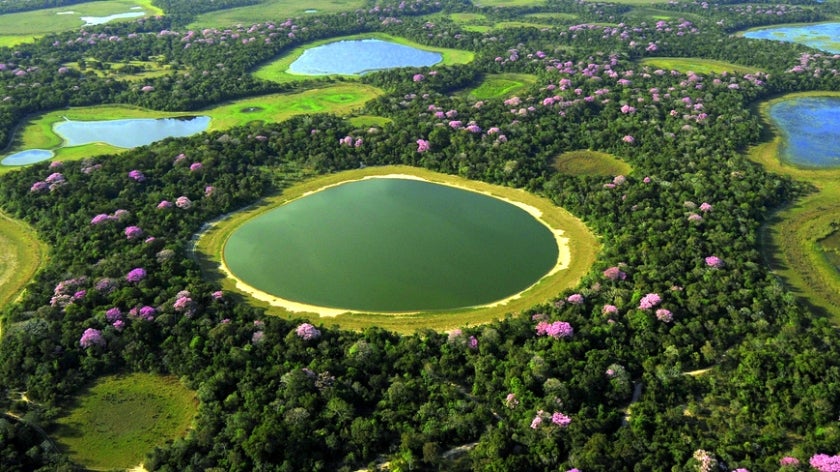
Photo credit: Zaruba Ondrej/Shutterstock
Protecting the global commons is not only the right thing to do – it improves the bottom line as well
In the middle of the COVID-19 crisis, companies are increasingly committing themselves to helping to stabilize the Earth’s climate. It is encouraging to see these commitments coming in thick and fast. However, what is also happening, a little less publicly, is that business leaders are recognizing that unless humanity urgently changes its relationship with the global commons – land, water, ocean, and biodiversity – pandemics and other crises will become more common.
For business, nature loss presents a growing material and existential risk. In the US, they are dealing with power blackouts and wildfires. In Brazil, the world’s largest tropical wetland, the Pantanal, is on fire, while major floods have hit China and Africa.
Environmental catastrophes are increasingly common and devastating, and are impacting companies, their employees, and their supply chains across the globe.
The loss of nature directly threatens economic activities responsible for generating over half the world's GDP. We must both halve greenhouse gas emissions by 2030 and reverse the loss of nature; neither is possible without the other. Without such action, economic growth and a better life are impossible.
At the same time, there is also a growing understanding that combatting these threats is not just the right thing to do but brings benefits such as increased investment, improved reputation, and overall competitive advantage to businesses.
Scientific and economic evidence shows that companies will increasingly thrive when they support thriving ecosystems. Companies with high ESG (environment, social, and government) ratings tend to do better than their peers. Sustainable investments have outperformed the rest of the market since the COVID-19 pandemic began. And putting sustainability at the heart of decision-making helps make businesses stronger and more likely to withstand systemic shocks. This is the economic engine of tomorrow.
Since 2015 companies have been able to use science to ensure their efforts to tackle climate change are sufficiently ambitious, through the Science Based Targets initiative. More than a thousand companies have now signed up to it, committing to reduce their emissions in line with what the scientific evidence requires.
But when it comes to playing their part in tackling nature loss, it is difficult for companies to know where to start or how to prioritize efforts. A dizzying array of business initiatives offer different pieces of the solution, but until now there hasn’t been a framework that ties them together. There has been growing demand for science-based targets from companies keen to ensure their efforts are aligned with science.
The Science Based Targets Network was formed to provide these, and has now published its first guidance for companies. This offers businesses consensus guidance on how to restore balance to the global commons by operating within Earth’s limits while meeting society’s needs. It defines how companies can assess, prioritize, measure, address, and track their impacts and dependencies on nature in line with science. And it introduces an action framework they can follow to avoid future impacts, reduce current ones, regenerate and restore ecosystems, and work to transform systems. Interim targets give companies direction they can align with across land use, freshwater use, climate impact, and ecosystem integrity.
Produced and reviewed by a broad grouping of environmental groups, scientists, businesses, and consultancies with the aim of defining a unified approach, the guidance was developed to consolidate and build on companies' many existing efforts to protect nature, and is aligned with global frameworks such as the UN Sustainable Development goals.
The guidance describes five steps businesses need to take to protect and restore the global commons, while staying competitive. The first is to assess the company’s entire value chain, examining all its impacts and dependencies on nature. Second, companies identify the ecosystems of highest value and the areas where people rely most heavily on nature for their lives and livelihoods, and key priority impacts and places for action.
Third, they measure baseline impacts and set targets that stay within Earth’s limits and contribute to societal goals. Fourth, they act on these targets, using a hierarchy to avoid impacts on nature, then reduce unavoidable impacts, and finally regenerate and restore critical ecosystems. They also need to consider how they might take transformative action within their organizations, across their supply chains and beyond. And finally, they track and publicly report progress on targets and actions.
We plan to engage with businesses to develop and refine all this in the coming months to make it as user-friendly and effective as possible. Our aim is to work with companies to rapidly iterate and help design the guidance for maximum usability.
Individual companies setting targets for nature is an important starting point. But it needs to be scaled rapidly with access to all networks and collaborations to drive uptake. We are living through some of the most disrupted, uncertain times in history. Businesses must reset their compasses, and chart a new course towards an equitable, net-zero, nature-positive economy. The private sector has the power to get us there and governments can – indeed, must – adopt ambitious policies that will support it in doing so.
The main risk is inaction. Now is the time to get started, as some of the steps required to prepare for science-based target-setting can take time to do well. The future of all life on Earth depends on us fundamentally changing our relationship with nature. We urge all companies to get involved and join us on this journey.
This piece was originally published for the GEF-Telegraph Partnership.