
The Country Engagement Strategy (CES) guides how the Global Environment Facility Secretariat convenes, communicates, and collaborates across the GEF Partnership to achieve our shared aims of achieving lasting global environmental benefits. The CES articulates how the GEF provides information, capacity-building, and technical support, enhances policy coherence and country ownership, and leverages financial, institutional, and political resources to enable recipient countries to achieve lasting global environmental benefits.
Constituency Engagement
Introduction Seminars occur twice a year, providing an overview of the GEF to new members of the partnership.
Constituency Meetings are held in advance of each GEF Council meeting. They provide a forum for countries within each GEF constituency to coordinate positions to be presented at Council. Chaired by the respective GEF Council Member, they convene Operational and Political Focal Points (OFPs, PFPs) and relevant representatives to solicit official views, build consensus on statements, and ensure representation in Council discussions.
Expanded Constituency Workshops (ECWs) bring the full breadth of the GEF partnership together in every constituency to review progress on GEF programming and policies, introduce new opportunities, exchange information, and strengthen cooperation. ECWs are held throughout the second half of the GEF programming cycle, upon constituency demand. Participants include OFPs, PFPs, Convention Focal Points, Agencies, and representatives from civil society organizations. ECWs are convened and financed by the GEF Secretariat.
Portfolio Planning and Capacity-Building
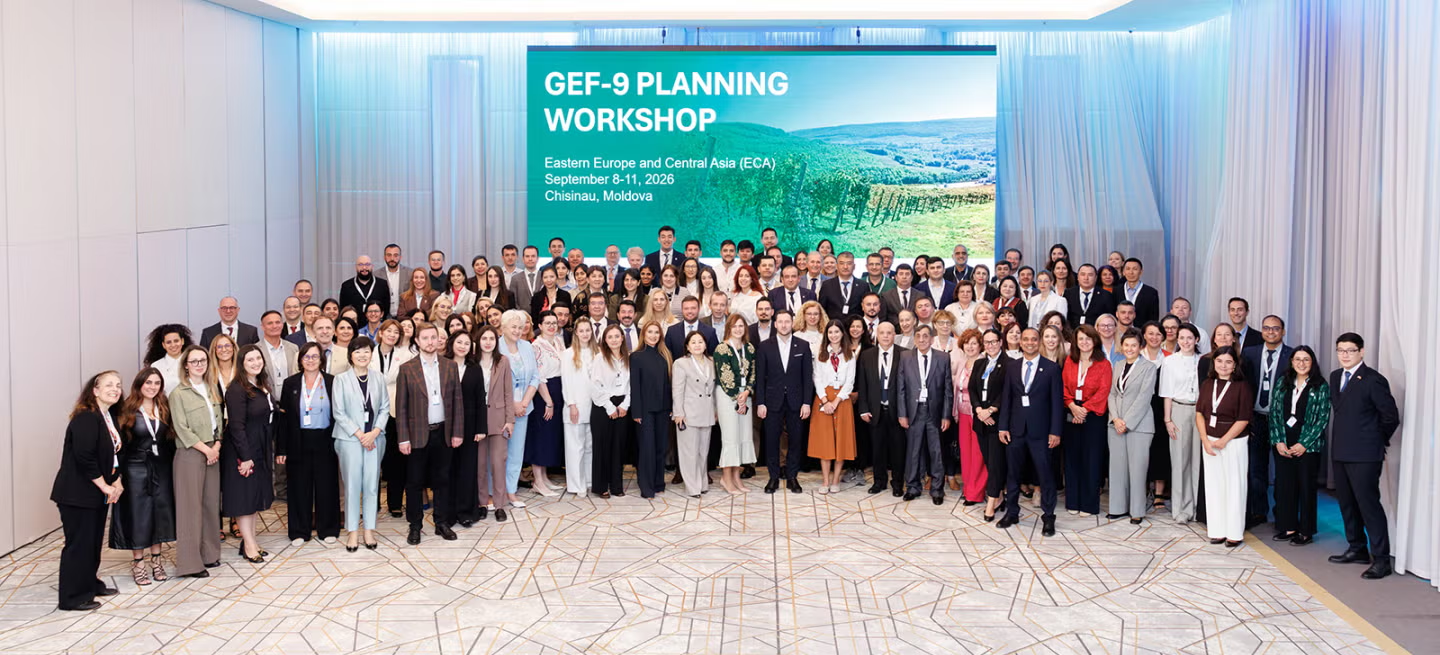
GEF Planning Workshops (GPWs), held in the first year of each replenishment cycle, convene OFPs, PFPs, and CSOs across regions of one or more constituencies, along with GEF Agencies and Secretariat technical and operational staff to discuss programming and policy directions and to plan country and regional investment portfolios.
Upstream Technical Dialogues provide technical support to OFPs to develop and manage their GEF portfolios. Dialogues may be virtual or in-person and are led by each GEF Regional Coordinator in response to interest from recipient countries, on a continuous basis throughout each replenishment cycle.
OFP and PFP Capacity-Building is held throughout each replenishment cycle and includes a diversity of offerings, from webinars and virtual meetings to in-person trainings, as well as the provision of knowledge products, such as technical briefs, videos, handbooks, and e-learning series.
The OFP Network is a planned virtual community linking OFPs in all recipient countries to provide core GEF information, training resources, portfolio dashboards, and updates related to policies and programming.
Advancing the Whole-of-Government Approach
National Steering Committees (NSCs) bring together line ministries in recipient country governments to integrate environmental priorities and investments towards shared development aims and strengthen policy coherence. Representation of civil society, Indigenous Peoples, women, and youth groups is encouraged. NSCs are voluntary and country-led. The GEF Secretariat provides technical support such as NSC Guidelines for committee formation and advisory services on committee convenings. The NSC Community of Practice provides a forum for exchange across committees.
National Dialogues are available to all recipient countries as country-led meetings that convene national stakeholders for participatory planning and programming of GEF investments in each cycle. National Dialogues and NSCs work hand-in-hand to enable inclusive GEF investment planning, aligned with national priorities across stakeholders and sectors. The GEF Secretariat provides National Dialogue Guidelines, limited financial support, and virtual or in-person technical support. Contact your GEF Country Relations Officer and Regional Coordinator (below) to schedule a National Dialogue.
Country Platforms leverage the important work of National Steering Committees to align GEF investments with those of other multilateral and bilateral funders, building policy coherence, investment synergies, and leveraging financing for greater, more durable environmental and development outcomes. Country Platforms are country-led and voluntary. The GEF Secretariat provides technical support, including guidelines, and participates in Country Platforms at the invitation of recipient countries.
Advancing the Whole-of-Society Approach
The GEF Civil Society Organizations Network is an independent global alliance of civil society organizations working to address global environmental challenges, aligned with the GEF’s scope and mandate. The CSO Network serves as the primary mechanism for structured civil society engagement with the GEF, including participation in Council meetings and replenishment processes.
The GEF Small Grants Program (SGP) provides support to civil society, Indigenous Peoples, local communities, women, and youth for projects in communities, landscapes, and seascapes on the frontlines of conservation and sustainable development. Since 1992, the SGP has provided $1.5 billion of GEF funding to CSOs, local communities, and Indigenous Peoples organizations across 136 countries for local environmental efforts.
The Inclusive Conservation Initiative (ICI) provides dedicated and direct funding to Indigenous-led organizations for their environmental stewardship of globally significant ecosystems and biodiversity. ICI programming will increase to $100 million in GEF-9.
The Fonseca Leadership Program supports the professional development of promising young conservationists from GEF recipient countries. The program selects Fonseca Fellows that are provided grants for research and field work, support for participation in international conservation events, capacity-building, and participation in a global network of young environmental leaders.
Related Topics


Resources
GEF Country Relations Officers and Regional Coordinators
Africa
- Susan Waithaka / swaithaka1@thegef.org
- Jonky Tenou / ytenou@thegef.org
Asia
- S.J. Yoon / syoon@thegef.org
- Hannah Fairbank / hfairbank@thegef.org
Eastern Europe, Central Asia and the Middle East
- Kholoud Hilaneh / khilaneh@thegef.org
- Evelyn Swain / eswain@thegef.org
Latin America
- Noemi Hernandez Rodriguez Borjas / nhernandezrodrig@thegef.org
- Patricia Marcos Huidobro / pmarcoshuidobro@thegef.org
Small Island Developing States
- Asha Bobb Semple / abobbsemple@thegef.org