GBFF in Focus: Guardians of the Highlands - community-led conservation in Papua New Guinea
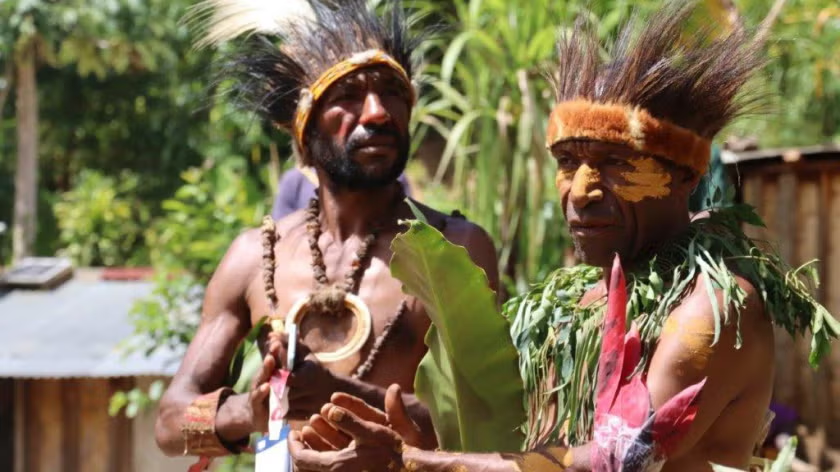
Photo credit: FAO
Since 2024, the Global Environment Facility's Global Biodiversity Framework Fund (GBFF) has moved from launch to full-speed operation with over $362 million in projects approved. GBFF in Focus is a series showcasing how the new biodiversity fund is changing the game for how countries can invest in nature.
High in the mist-draped mountains of Papua New Guinea's Highlands, a tree kangaroo moves through the cloud forest, invisible to most of the world. Below, in villages connected by footpaths rather than roads, Indigenous communities have protected these forests for generations — not through formal conservation plans, but through customary stewardship woven into the fabric of daily life. A new GBFF project, implemented by the Conservation and Environment Protection Authority (CEPA) of Papua New Guinea and the Food and Agriculture Organization of the United Nations (FAO), aims to recognize, strengthen, and sustain that stewardship for the long term.
Papua New Guinea is one of only 17 megadiverse countries on Earth. Its Highlands region shelters species found nowhere else: tree kangaroos, long-beaked echidnas, some of the world's rarest birds-of-paradise, and the Goliath birdwing — the world's second largest butterfly. Roughly 80 percent of the country's forest cover remains intact, a testament not to the absence of people, but to their presence. Indigenous Peoples and local communities own 97 percent of the land, and their millennia-old management practices are the single most important reason PNG's ecosystems remain among the most biodiverse on the planet.
Yet this natural wealth faces growing pressure. Population growth, economic expansion, and the appeal of logging and mining revenues are pushing into landscapes that have remained intact for centuries. Despite their outsized role in conservation, local communities receive little formal recognition or support for their efforts. PNG's protected area network covers less than 4 percent of national territory — far short of the 30 percent called for under the Kunming-Montreal Global Biodiversity Framework's Target 3. Community conservation initiatives — conservation deeds, sacred traditional sites, proposed community conservation areas — exist in practice but remain largely invisible to national accounting systems.
The new GBFF project, Community-Led Conservation and Sustainable Landscapes in Papua New Guinea's Highlands, targets the provinces of Enga, Chimbu, and Jiwaka, covering over 2.2 million hectares of some of the country's most ecologically significant terrain. Working on three levels — national, landscape, and community — the project is designed to make the invisible visible: to ensure that the conservation work communities are already doing is recognized, resourced, and connected to PNG's national biodiversity commitments.
Building on the 2024 Protected Areas Act, the project will strengthen traditional customary frameworks of stewardship, governance, and land tenure. This means working with communities to develop participatory zoning and land-use plans that blend traditional knowledge with modern tools, establishing community-based monitoring systems, and creating governance mechanisms that are genuinely inclusive and gender-responsive. By formalizing community conservation areas as Other Effective Area-Based Conservation Measures (OECMs), the project will help PNG count its true conservation footprint — and close the gap toward 30x30.
The project will support improved management of over 272,000 hectares of protected areas and OECMs, restore 5,000 hectares of degraded ecosystems, and apply biodiversity-friendly practices across more than 7,000 hectares of cropland. Beyond those figures lies a deeper ambition: to establish well-connected biodiversity corridors across the three Highland provinces that enable species to migrate, ecosystems to adapt to climate change, and communities to cooperate across traditional boundaries.
In a region where land disputes have sometimes fueled tribal conflict, conservation can be a tool for peacebuilding. Projects like the proposed Velotige conservation area have shown how community-led initiatives create shared purpose across kinship lines, turning a contested landscape into a collectively managed one. The project will actively support such social cohesion, recognizing that conservation governance and community resilience are inseparable.
Economic alternatives are central to the design. Communities will be supported to develop organic farming, sustainable agroforestry, and ecotourism enterprises — reducing reliance on extractive industries while expanding markets for certified coffee, non-timber forest products, and other biodiversity-friendly goods. The project will also explore whether parts of the Highlands qualify for designation as Globally Important Agricultural Heritage Systems (GIAHS), linking the region's traditional cultivation practices to global recognition of their conservation value.
One of the project's most distinctive contributions is its focus on sustainable financing. Three model landscape incentive mechanisms — drawing on approaches such as payments for ecosystem services, green bonds, and biodiversity offsets — will be piloted and refined for potential scale-up. REDD+ initiatives and other financial tools will be leveraged to support the long-term viability of protected areas and OECMs. At the national level, the project will support the development of financing strategies and planning frameworks that align provincial and national biodiversity commitments with the resources needed to deliver on them.
At least 20,000 people — half of them women — will benefit directly from the project's investments, through improved livelihoods, stronger governance, and a knowledge platform that connects communities, government, and civil society across the three provinces.
What makes this project significant extends beyond its targets. Papua New Guinea offers a rare example of a country where Indigenous land rights are not a contested aspiration but an established legal reality — and where the communities holding those rights are already, quietly, doing the work of conservation.