

Civil Society
Since its inception, the Global Environment Facility has recognized the role that civil society plays in safeguarding the global environment. The diversity of organizations which have been steadily and increasingly participating in GEF activities include non-state actors, including not-for-profit and non-governmental organizations (NGOs), farmers, women, the scientific and technological community, youth, and children, Indigenous Peoples and their communities, business and industry, workers, and trade unions.
From identification, execution, and monitoring of GEF programs and projects, to influencing its governance and decision-making process, to liaising with communities, and advocating with governments, civil society has become one of the GEF's key partners.
An Updated Vision for Civil Society Engagement
In November 2017, the GEF Council approved an Updated Vision to Enhance Civil Society Engagement with the GEF. This document is designed to complement and reinforce key dimensions of civil society engagement with the GEF, particularly in the design and implementation of GEF projects and programs. These are addressed in more detail in the Policy on Stakeholder Engagement, Policy on Gender Equality, Policy on Environmental and Social Safeguards and Principles and Guidelines for Engagement with Indigenous Peoples.
GEF Small Grants Program
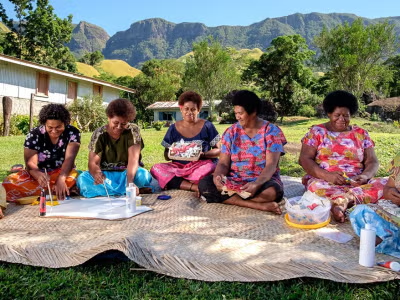
The Global Environment Facility's Small Grants Program (SGP) is a corporate program that has been a unique and essential element of the GEF’s work since its establishment in 1992. It has consistently provided a highly important avenue to work closely with civil society organizations (CSOs) and community-based organizations in support of the GEF’s mission and mandate. It has served as an essential piece of the GEF’s larger and increasing efforts to support inclusion and strong engagement of civil society stakeholders and partners, providing financing as well as technical and capacity-building support to Indigenous Peoples, local communities, women, and youth.
SGP provides financial and technical support to communities and CSOs to meet the overall objective of "global environmental benefits secured through community-based initiatives and actions." Taking “local action, global impact” as its core mission, GEF SGP has been supporting local and regional communities and CSOs, by financing innovative projects through a long-term commitment to community-based sustainable development.
Related Topics


GEF Civil Society Organizations Network
The GEF Civil Society Organizations Network is an independent global alliance of civil society organizations working to address global environmental challenges across the five GEF focal areas.
It serves as the primary mechanism for structured civil society engagement with the GEF, including participation in GEF Council meetings and replenishment processes. It connects CSOs with the GEF Secretariat, Agencies, and member governments, and facilitates meaningful participation in GEF policy processes, consultations, and programming cycles.
The Network began in 1995 when the GEF Network of Non-Governmental Organizations was formed as a voluntary structure of environmental CSOs working in at least one of the GEF focal areas.
The CSO Network operates through a global governance structure led by elected Regional Focal Points forming a Coordinating Committee, ensuring representation across regions and thematic areas. Its work spans policy engagement, capacity building, community networking, and support for civil society organizations navigating GEF processes and partnerships.
Eligible civil society, youth, women, and Indigenous Peoples organizations can join the CSO Network by completing the Membership Application Form.
For more information, please contact the following people:
- Faizal Parish, Chair of the GEF CSO Network at faizal.parish@gefcsonetwork.org
- Sagar Aryal, Vice-Chair of the GEF CSO Network at sagar.aryal@gefcsonetwork.org
- Muhammed Ameen Keryo, Secretariat of the GEF CSO Network at secretariat@gefcsonetwork.org
Selection Criteria
Selection Criteria for Council
As per the decision approved by Council in November 2017 contained in the Updated Vision, the GEF Secretariat will be responsible for the selection of sponsored CSOs for Council consultations and meetings to ensure that CSO representatives are sharing the voices of CSOs from the field, while maintaining robust engagement on policy issues. This selection will be done in a transparent manner, based on clear criteria and in consultation with the CSO Network, Operational Focal Points (OFPs), the Indigenous Peoples Advisory Group (IPAG) and the GEF Small Grants Program to establish a comprehensive list of CSOs from which to draw those to be sponsored to attend the Council meetings. Please find the approved criteria here.
Selection Criteria for Civil Society Participants in the Expanded Constituency Workshops
The Expanded Constituency Workshops (ECW) are organized by the GEF Secretariat to keep the GEF Focal Points, convention focal points and other key stakeholders, including civil society, abreast of GEF strategies, policies, and procedures. In addition, they (are) meant to provide a space to analyze, in depth, the various aspects of GEF work, to provide an opportunity to exchange knowledge and experience, and to encourage collaboration.

Opportunities
The GEF remains committed to further enhancing its engagement with CSOs to improve the effectiveness and efficiency of operations. Civil society stakeholders are encouraged to engage with the GEF by:
- Commenting on project proposals: Since GEF Agencies are required to consult CSOs for project approval, these may comment on project proposals, or be involved in project consultations, by contacting the GEF Agency project officer for a particular project and/or the operational focal point at the government level. The GEF Project Identification Form (PIF) for each project also indicates the project contact person, and are available in the GEF project database.
- Commenting on policies: GEF policy proposals are published in advance of GEF Council meetings on the Council documents webpage. Stakeholders can contribute by providing inputs, feedback, suggestions and recommendations through their regional CSO representative in the GEF CSO Network, through GEF Council Members, or by directly sending their comments on the GEF website ongoing consultations tab.
- Supporting project implementation, monitoring and evaluation: Civil society organizations play an important role in monitoring project and program activities along with GEF Agencies and GEF Focal Points, as well as in providing feedback as beneficiaries or as representatives of community groups, including through the GEF Independent Evaluation Office.
- Participating in GEF events: GEF Council meetings are webcasted live and their recordings uploaded onto the GEF YouTube channel. Civil society stakeholders may also apply and be selected to attend these Council meetings, as indicated in the Updated Vision. Also, the GEF Country Engagement Strategy provides opportunities for stakeholder engagement and learning about the GEF’s work and activities, including through Expanded Constituency Workshops (ECWs).
- Making a formal complaint or grievance relating to GEF projects and operations, including concerns about possible corruption or fraud: The GEF Conflict Resolution system provides stakeholders with an avenue to submit complaints or concerns about GEF-supported projects and operations. These may be submitted to the responsible GEF Agencies and/or the GEF Conflict Resolution Commissioner. In addition to the above, the World Bank staff rules on matters of ethics, integrity, fraud and corruption apply to staff of the GEF Secretariat, while the GEF’s Policy on Ethics and Conflict of Interest for Council Members, Alternates, and Advisers applies for these individuals. Any concerns on these matters may be raised through the World Bank hotline.
Resources
For reference, GEF policy and guiding documents on public involvement and civil society engagement are made available through weblinks below:
- Updated Vision to Enhance Civil Society Engagement with the GEF (GEF/C.53/10/Rev.01)
- Policy on Stakeholder Engagement (GEF/C.53/05/Rev.01)
- Guidelines to Implement the Policy on Stakeholder Engagement (SD/GN/01)
- Evaluation of the GEF CSO Network (GEF/ME/C.50/02)
- Management Response to the Evaluation of the GEF CSO Network (GEF/ME/C.50/03)
- Policy on Gender Equality (GEF/C.53/04)
- Policy on Environmental and Social Safeguards (GEF/C.55/07/Rev.01)
- Principles and Guidelines for Engagement with Indigenous Peoples
For more information, please contact gefcivilsociety@thegef.org.