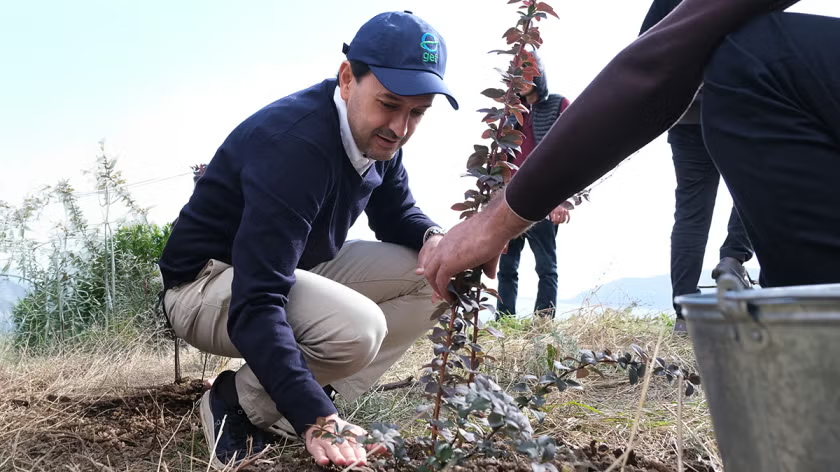
GEF CEO Diego Mesa Puyo at a project site near Lake Sevan, Armenia, on the sidelines of CBD COP17. Photo credit: GEF
Diego Mesa Puyo is CEO and Chairperson of the Global Environment Facility. In a GEF Voices interview, he shared lessons from his career path spanning finance, energy, and government, made the case for increased investment in nature-positive activity, and offered advice to young people starting out: build skills, stay curious, and work hard.
What do you do for a living?
I lead an international organization that invests in a more sustainable future. The GEF provides funding for projects and initiatives that directly support countries’ commitments on nature, climate, and pollution. Environmental priorities must be integrated into countries’ economic and development agendas, or else positive changes won’t last. We fund ambitious, nature-positive, and bankable initiatives that make sense for countries’ broader economic growth and development priorities.
What are your priorities for the GEF?
I sum this up in three words: integrate, catalyze, and deliver. Integrate environmental and development priorities. Catalyze larger pools of capital for nature and the environment using blended finance, which mixes public and private funds, and other innovative tools that bring in much more private investment. And deliver results, quickly and at scale, that make a real difference for countries and communities.
How did you get into this line of work?
I am an economist by training and have spent much of my career working at the intersection of public policy, finance, energy, and economic development.
I worked for many years at the International Monetary Fund advising governments on fiscal policy and natural resource wealth. I also worked in the private sector in Canada, advising public and private clients on economics and finance. I then moved from advising governments to working inside one, serving as Colombia’s Minister of Mines and Energy from 2018 to 2022. In Colombia, I led the launch of the country’s first variable renewable energy auctions, including the first double-sided action for clean electricity globally, helping attract more than $3 billion in private investment and accelerate wind and solar power. I also worked closely with the ministers of environment and finance to enact the Energy Transition and Climate Action Laws in 2021, as well as to launch the first green taxonomy in the Americas in 2022.
I later returned to the IMF to focus on resilience and sustainability, which had become increasingly central to macroeconomic stability. In my most recent role there before joining the GEF, I advised countries across all regions on climate-related fiscal policy, helping them design policies to strengthen resilience and promote sustainable economic growth.
What first prompted your interest in the environment?
Growing up in Colombia and studying in Canada certainly shaped me. Both countries are extraordinarily rich in nature, natural resources, and biodiversity. Both are also grappling with difficult questions about how to create jobs, provide clean and abundant energy, grow the economy, and improve people's lives while protecting the natural systems on which that prosperity ultimately depends. These are not always easy challenges to take on.
This was very clear to me during my time in government. I came to see that protecting nature and addressing environmental pressures cannot sit on the margins of economic policy, if they are truly priorities. They have to be considered together. Healthy ecosystems support water, food, jobs, resilience, and ultimately economic growth. That is why I do not see environmental conservation and economic development as competing objectives. They need to reinforce each other.
What GEF-funded projects are close to your heart?
I am especially drawn to projects that show that economic development and environmental protection are complementary and mutually reinforcing.
One example is the Wildlife Conservation Bond, often called the Rhino Bond, in South Africa. It connects finance directly to a measurable conservation result: investors are rewarded when black rhino populations increase, with a payout funded by the GEF. This has laid the groundwork for a whole new asset class of biodiversity bonds that meet the risk-return profile needs of institutional investors.
Another is the Blue Nature Alliance, where GEF funding has helped unlock much larger amounts of financing for ocean conservation across dozens of countries. It now helps protect nearly 3 billion hectares – about 8 percent of the world’s ocean. About $40 million in GEF grants has brought in $302 million in additional funding, almost all of it from philanthropies and the private sector.
I am also very glad to see Dominica, a Small Island Developing State, benefiting from the first geothermal power plant in the English-speaking Caribbean following a suite of support from the GEF in partnership with the World Bank. This power plant will provide clean, reliable, and affordable electricity, with hurricane-resilient underground transmission lines. The GEF blended finance and grant support was approved quickly, helping the project advance sooner, and it is now benefitting tens of thousands of people.
What I like most about these projects is that they turn big ideas into something people can see and measure – more black rhinos, a healthier ocean, and clean, secure and affordable energy: all of which support the communities and economies who depend on them.
The state of the global environment can be concerning. What gives you hope?
The trends are concerning, and I think we have to be honest about that. But I am fundamentally optimistic because we know that recovery is possible.
We have seen wild tiger populations rebound, green sea turtles’ loss reverse, and bluefin tuna population recover following stronger, science-based management. The lesson I take from these examples is that decline is not destiny. When we set clear goals and coherent policies, build capable institutions, and create the conditions for long-term private investment, nature can respond.
What advice would you give a young person interested in a career like yours?
My advice would be: build strong, transferable skills, stay curious, be passionate about what you do, and work hard.
My own career has taken me through economics, finance, energy, government, climate policy, and now the environment. I could not have planned the whole journey at the beginning. What helped was developing skills that could travel across those different worlds, staying disciplined and being willing to learn new things, and taking opportunities where I felt I could contribute.
I would also encourage young people to get practical exposure. Spend time understanding how governments, businesses, and communities actually make decisions. Environmental progress depends on connecting big ambitions to the realities of budgets, institutions, and, most importantly, people's lives.
And remain optimistic. This field can sometimes feel overwhelming because the problems are enormous. But that is exactly why talented young people are needed. There is no shortage of meaningful work to do.