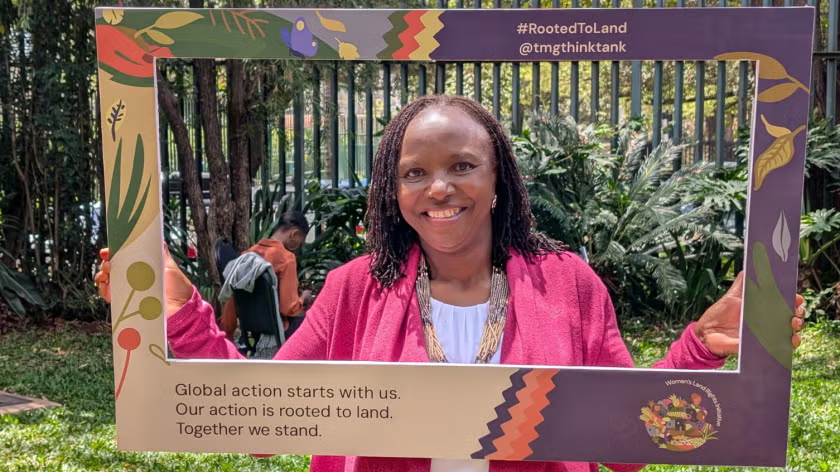
Photo courtesy of Esther Mwaura Muiru
Esther Mwaura Muiru is Global Advocacy Director for the Stand For Her Land initiative at Landesa, a non-profit organization working to obtain legal land rights for women and impoverished families. In a GEF Voices interview, she reflected on the important and often overlooked roles that women play in dealing with disasters, improving agricultural productivity, and supporting forest and water management.
What do you do for a living?
I am a development practitioner with a special interest in public policies and the implementation of projects and programs that transform the lives of women and their communities living in poverty and at the margins of development.
I work with local organizations to build a strong grassroots women-led movement so that government and development partners will prioritize actions that allow women’s access, control, and ownership of land in order to equalize decision-making power, raise economic opportunities, address climate change impacts, and improve food security.
How did you get into this line of work?
I was born and brought up in a region of Kenya that pre-independence was known as the white highlands. Indigenous families lost their land to the British Colony and the land was later reverted back to Kenya through a willing-buyer willing-seller process. The majority of us grew up as laborers to large landowners who had investments in pyrethrum, livestock, and tea and flower plantations. Thus, I was confronted with land inequality in my childhood.
Over the last 35 years, I have built a career focused on the empowerment of women. I have witnessed how control of land and natural resources helps women deal with disasters and climate change impacts, improves agricultural productivity, and strengthens their capacity to influence public policies and financing including on forests and water management.
Is there a GEF-funded project or program that is close to your heart?
The GEF project closest to my heart is the Mainstreaming Sustainable Land Management in Agropastoral Production Systems of Kenya project, completed by UNDP in 2016. What moved me about this project was that the implementation process understood that healing the land starts with the women who wake up every day and work it. Over 11,000 farmers, most of them women, were reached, and for the first time, these women had a seat at the table when decisions about their land were made. That shift, from invisible to decision-maker, is the kind of change that does not just restore land; it restores their dignity, heritage, and lives.
Has anyone you have met through your work made a lasting impact on you?
Ohh yes. While a student at University of Nairobi, I worked as a research assistant to university professors including Prof. Wangari Mathaai. She was a vivid protector of land and the natural environment. She inspired me a lot. After I graduated, I was one of the young people who participated in the 1995 UN Women Conference in Beijing, China. One of the tasks given to me by the Kenya delegation was to support Prof. Wangari Mathaai’s logistics for her speaking roles. I got to know her more closely. She became one of my biggest champions as I walked the journey of establishing a grassroots women movement and women rights organization - GROOTS Kenya. It is at GROOTS Kenya that I invested valuable years of my career as a young development professional and learnt almost all that I do now in my work. I led the organization for 23 years to help secure women’s land rights in Kenya. Prof. Wangari Mathaai remained a great motivator to me until her death.
What life lessons has your job taught you?
In the development sector, having excellent skills to do the work is very important, but sustainable outcomes are also delivered through passion, consistency, and commitment to positively transform people’s lives and save nature, transcending the confines of institutions.
The state of the global environment is concerning. What gives you hope?
My hope lies in the collective work of women living in rural, Indigenous, and pastoralist communities. Their daily lives are so comprehensive, supporting families with income, food, water, health, education, ecosystem protection, etc. Supporting Indigenous women’s work can deliver sustainable outcomes for generations.
What advice would you give someone interested in a career like yours?
Understanding the lived realities of people and nature within their ecosystem (local, national, global) is key. Then reflect on what you are passionate about, ideally with the help of a mentor. Finally, steadily build the necessary skills to make positive changes as you engage with the work. Never take up a career just because it has a better opportunity to pay you, in the development sector.