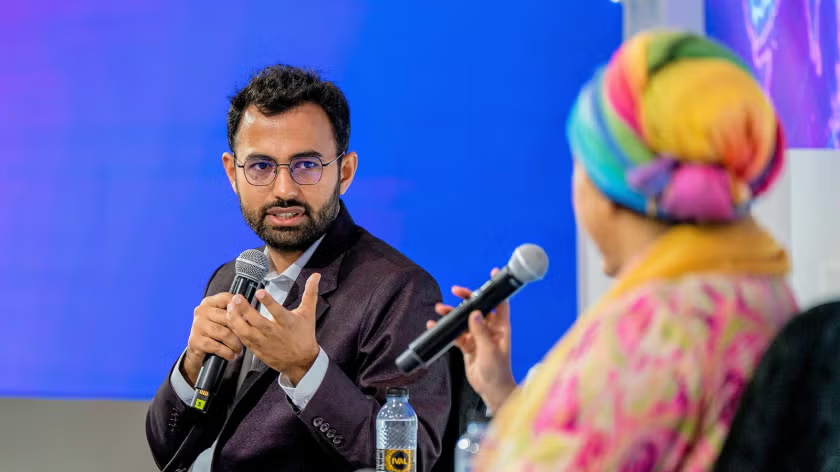
Photo courtesy of Sagar Aryal
Sagar Aryal is Vice Chair of the GEF CSO Network and Chief Technology Officer at Plant-for-the-Planet, an organization working to scale forest restoration. In a GEF Voices interview, he shared life lessons from his work using technology to restore forests, connect people, and raise funds for vital initiatives.
What do you do for a living? What are you currently focused on?
I am the Chief Technology Officer at Plant-for-the-Planet. My team builds Forest Cloud, the open-source digital infrastructure behind our work to scale forest restoration. It is one core with many tools, and at its heart is our Restoration Platform. More than 300 community groups and non-profit organizations in over 70 countries use it to raise donations for their work.
What makes it different is that it is built to be checked. An independent review board sets the standards, and only verified organizations can receive donations. Projects can then show their progress with data from the ground, collected in TreeMapper, our app for recording each tree from a phone, where it stands and whether it is still alive. The data stays with the people who collected it. Right now I am focused on making these tools work for small community groups and for cities, not just large organizations.
I am also Vice Chair of the GEF's Civil Society Organizations Network, where I work to give civil society a real say in how the fund works.
How did you get into this line of work?
Through my father, really. I grew up in a village in the foothills of the Himalayas, and he volunteered for environmental causes while working many jobs. I was too young to understand the science, but his commitment slowly taught me about the mountains, the melting snow, and the floods and landslides that follow.
When I was 10, with his help, I started the Sano Sansar Initiative, which means "small world." It began as a reader's club, a place for young people like me to collect books, read them, and talk about how to solve big problems. Over time it grew into debates, campaigns and workshops on climate and the environment. We did not plant trees. We helped young people understand the climate crisis well enough to speak up.
A few years later, at a children's conference in Norway, I heard about Plant-for the-Planet. It had been started by a 9-year-old, and it made me feel I was not alone. I joined at about 15, and in 2012 I was elected president of its global board. Technology started as a hobby, after I first used a computer in 2005. Over time it became the way I could help the most people at once, and I have been building tools for this work ever since.
Is there a GEF-funded project or program that is close to your heart?
Two, and both are about big cats.
The first one goes back to Nepal. When I was running Sano Sansar, I came across a tiger project in and around Chitwan National Park, run with Nepal's National Trust for Nature Conservation. The idea was to give tigers and rhinos a forest corridor, so they could move between the park and the hills. I never went there. Later, WWF carried this kind of work across Nepal's protected areas and corridors, also with GEF support. A few years ago, I read that Nepal had nearly tripled its tigers. This year's count is 429, more than three times the 121 counted in 2009.
The second is in Mexico, and it is closer to my work today. About 20 the GEF helped fund a biological corridor across the Yucatán Peninsula. The project tracked jaguars and helped set up a fund to pay ranchers when big cats took their cattle. Today Plant-for the-Planet restores forest in Campeche, next to the new Balam Beh jaguar corridor.
If I had to name the part of the GEF I care about most today, it would be the Small Grants Program and Inclusive Conservation Initiative, because it puts money directly into the hands of Indigenous Peoples and local communities.
Has anyone you have met through your work made a lasting impact on you?
Jane Goodall. I got to work with her on Trees for Jane, a campaign to protect and restore the world's forests, and I spoke with her on several calls.
What stayed with me was how often she came back to one idea, that none of us can do this alone and we have to come together. She was still saying it in her late eighties, when we spoke, and she kept travelling to say it almost to the end. She died in October 2025. Now, when we build something new, we ask whether it brings people together, or just adds one more tool.
What life lessons has your job taught you?
The biggest lesson is to listen. In the last few years, I've been fortunate to visit many communities and people who are working to protect nature, including with GEF support. I've learned the value of hearing the stories of the people who are closest to nature. Their stories carry a wealth of knowledge and culture: how people and nature have lived together for generations, long before any of us arrived with a project or an app. That is why, when we build, we try to start with those stories.
The other lesson is that children often teach us more than we can teach them. They simplify problems and often come up with simple solutions. When a problem feels personal, people give everything to solving it, and for young people the climate crisis is personal. It is about their future.
The state of the global environment is concerning. What gives you hope?
The people who are adapting and creating solutions, and who do not lose hope. I hear their stories from the ground all the time, from restoration projects, from farmers and from children. So many of them are about someone solving a problem with very little, and still going when the funding stops. They need to be trusted, and supported with technology and finance on time.
And they are not waiting for technology to be handed to them. They are taking it and making it work for them. With a phone, and now with AI, a farmer can ask questions that used to need an expert, often in her own language, and show the world what she has done. Knowledge that sat with a few people for so long is now within reach of far more of us.
What will you be focused on at COP17 in Armenia?
Finance is crucial. We have enough money to fight wars, but not enough for education, or to support the people who restore and protect the planet that gives us everything. That is why I am looking forward to the conversations at COP17 about who actually gets access to that money.
I also want to meet two kinds of people: the innovators building new ways to protect and restore biodiversity and ecosystems, and the people doing the work on the ground. I am a big believer that innovation should work hand in hand with the custodians of nature, so that we build the solutions they need. That is also why I hope to see Indigenous Peoples and local communities move from the margins of the agenda to the center of it.
What advice would you give a young person today who is interested in a career like yours?
Don't wait until you feel ready, and don't wait for permission. I started at 10, and nobody asked me to.
Then, don't hesitate to ask questions. That is why I chose to study philosophy: it taught me to question everything. Tools change fast, and today a machine can even write code for you. What it still cannot do well is decide which question is worth asking. Asking good questions is how you learn to think.
And go out, into nature and into communities. Make new friends. Share your story, and listen to theirs. Most of what I have built started with a conversation.