
Farmer Nima Elmassad harvests drought-resistant crop varieties in Sudan’s White Nile State. Photo credit: Lisa Murray/UNEP
Vulnerable countries are set to receive new support to strengthen resilience under a package of projects approved by the Least Developed Countries Fund (LDCF) and Special Climate Change Fund (SCCF) Council, alongside a new strategy to guide the funds through 2030.
Meeting in Samarkand ahead of the Eighth GEF Assembly, Council members approved the final LDCF/SCCF Work Program of the GEF-8 period, comprising seven projects under the Least Developed Countries Fund and one project under the Special Climate Change Fund. Together, the projects will provide over $67 million in new LDCF and SCCF resources, while mobilizing nearly $218 million in co-financing.
The new initiatives will support priorities in Bangladesh, the Democratic Republic of Congo, Guinea-Bissau, Niue, Senegal, Solomon Islands, Sudan, and Togo. They will help countries reduce flood and coastal risks, strengthen food and water security, protect ecosystems, improve disaster preparedness, and expand resilient economic opportunities for vulnerable communities.
Claude Gascon, GEF Interim CEO, said the latest tranche of programming responded to evolving national needs, showing how targeted finance was essential in helping countries advance their adaptation priorities while leveraging wider partnerships.
“The work program reflects this demand and the continued relevance of these funds,” Gascon said. “It also shows the catalytic nature of the LDCF and SCCF – working with MDBs and other climate funds, and increasingly supporting multi-trust fund projects that align resources across the GEF family of funds.”
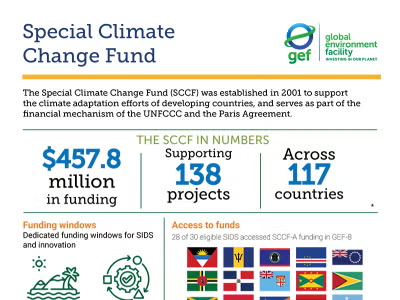
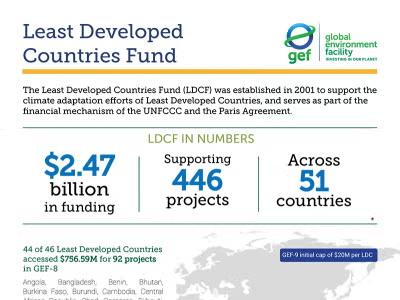
The approval concludes a significant period of delivery for the two adaptation-focused funds. With this work program and pending medium-sized projects, the LDCF will have supported 90 projects and programs during GEF-8, reaching 44 Least Developed Countries, with total programming of more than $750 million. Over the same period, the SCCF is expected to support 40 projects, including 25 projects benefiting non-LDC Small Island Developing States through its dedicated SIDS window, alongside support for technology transfer, innovation, and private sector engagement.
Council members also endorsed the GEF-9 Programming Strategy on Adaptation to Climate Change for the LDCF and SCCF, setting the direction for programming under the two funds from July 2026 to June 2030. The strategy sets out a framework for helping vulnerable countries move from adaptation planning to implementation, with increased emphasis on integrated solutions, locally led action, innovation, private sector engagement, blended finance, and stronger collaboration across climate funds and development partners.
Evans Njewa, speaking on behalf of Ambassador Adao Soares Barbosa, Chair of the LDC Group, welcomed the work program and strategy while emphasizing the continued importance of predictable support for Least Developed Countries in the face of intensifying climate impacts.
“These discussions are not merely procedural. They shape whether adaptation support reaches the countries and communities that need it most,” Njewa said. “Each approval, each endorsement, and each new strategy represents a step closer to a world where the most vulnerable are empowered, supported, and included in the transition toward a climate-resilient future.”
The GEF-9 LDCF/SCCF Programming Strategy sets out two financial scenarios for each fund – ranging from $1 billion to $1.3 billion for the LDCF, and from $200 million to $300 million for the SCCF – while introducing operational improvements to further strengthen access, delivery, innovation, and finance mobilization. Together, these measures are designed to help the LDCF and SCCF provide more predictable, catalytic support for Least Developed Countries and Small Island Developing States.
Several projects approved in the latest work program will support countries facing overlapping pressures from climate vulnerability, fragility, and development constraints. The work program includes projects in four fragile and conflict-affected states – the Democratic Republic of Congo, Guinea-Bissau, Solomon Islands, and Sudan – with interventions designed to strengthen inclusive resilience, improve local services, support livelihoods, and reduce climate-related risks to communities and ecosystems.
Examples include support for climate-resilient services and urban planning in Solomon Islands, and an SCCF-backed initiative in Niue combining resilient infrastructure, ecosystem-based coastal protection, and conservation finance linked to the blue economy.
The work program also reflects the growing role of the LDCF and SCCF in leveraging wider sources of finance. The LDCF projects are expected to mobilize $207.9 million in co-financing, while the SCCF project in Niue is expected to mobilize $9.8 million. Several projects involve multilateral development banks and international financial institutions, as well as multi-trust fund approaches that align LDCF and SCCF financing with broader GEF investments.
Gascon said the decisions in Samarkand would help provide continuity and predictability for countries relying on LDCF and SCCF support.
“With just a few years remaining to deliver on global commitments to 2030, the role of these funds is even more central,” he said. “By endorsing the strategy, this Council has provided a clear framework for the years ahead. The momentum is there, the demand is clear, and the opportunity is in front of us.”