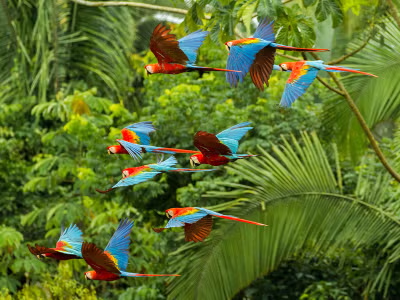


Photo credit: Neeraj Khera/CONSERVE PPG
Since 2024, the Global Environment Facility's Global Biodiversity Framework Fund (GBFF) has moved from launch to full-speed operation with over $362 million in projects approved. GBFF in Focus is a series showcasing how the new biodiversity fund is changing the game for how countries can invest in nature.
In Khonoma, a village in the hills of Nagaland, the forest has been closed to hunters since 1998, a decision made not by government decree, but by the village council itself. In Sendenyu, a community biodiversity reserve has grown to 2,200 hectares over 25 years, stewarded entirely by the people who live alongside it. In the Van Panchayat forests of Uttarakhand's Lansdowne foothills, women firefighters guard the trees each dry season - protecting an entire watershed through work that is skilled and community-driven. And along the shores of Dumbur lake in Tripura, around five thousand fishing families depend on a reservoir that has no formal management plan. These communities are not waiting to be included in India's biodiversity story, they are already writing it. What they have long lacked is recognition, resources, and a formal seat in the systems that decide the future of the landscapes.
The new GBFF project Conservation of Biodiversity, its Sustainable Use, Fair and Equitable Sharing of Benefits in India (CONSERVE), will invest over $75.6 million across Nagaland, Tripura, and Uttarakhand to formally recognize community-managed forests, wetlands, sacred groves, and high-altitude meadows, giving communities governance rights, access to finance, and a place in India's official biodiversity architecture for the first time.
A land under pressure
India is one of the most biodiverse countries on Earth, home to 8 percent of the world's known species on just 2.4 percent of its land area, sitting at the intersection of four global biodiversity hotspots: the Himalayas, the Western Ghats, the Indo-Burma region, and Sundaland. But the landscapes that hold this richness are under growing strain. In Nagaland, jhum (shifting cultivation) cycles are shortening under economic stress, now averaging less than five years in some areas, putting pressure on forest regeneration. In Tripura, invasive Mikania micrantha, a fast-spreading vine from South America requires active management to protect native vegetation. And in Uttarakhand, Himalayan glaciers retreating 10–15 meters every year are reshaping watersheds that tens of millions of people depend on.
The people who keep the forest alive
Tribal communities are not a side story in CONSERVE, they are its backbone. In Nagaland, over 88% of the population belongs to Naga tribal groups, with village councils exercising customary authority over forests that have never been formally transferred to the state. In Tripura, tribal communities make up 31 percent of the population, concentrated in autonomous district council areas. In Uttarakhand, they form the majority in many of the Van Panchayat landscapes where the project will work.
More than 25,000 people, at least half of them women, will be directly engaged in identifying, mapping, and managing these conservation areas. Each management plan will be co-developed through Free, Prior and Informed Consent processes, co-designed with village councils and Biodiversity Management Committees. Communities will not just be consulted, they will co-author the rules of governance for their landscapes. Revenue-sharing agreements will channel financial flows directly back to community institutions, and at least 40 percent of Access and Benefit-Sharing beneficiaries will be women or women-led groups.
"This project aligns well with our development priorities,” said Dhananjay Mohan, former Principal Chief Conservator of Forests of the Uttarakhand Forest Department. “The outer hills of Uttarakhand — areas that have rarely been considered for any conservation project — are where the impact will be most visible. The Van Panchayats are active, the community spirit is strong, and CONSERVE can strengthen people-centric conservation efforts here."

Making the invisible visible
At the heart of CONSERVE is a simple but powerful idea: that India's forests are already being conserved by the people who live in them, and that formalizing this - giving it legal recognition, data, and finance - is both more effective and more just than building conservation systems around them. The project will pilot the full recognition process for community-managed areas across at least five sites covering 5,000 hectares and produce a replication toolkit that other Indian states can use once national guidelines are officially released.
CONSERVE will also bring together decades of scientific data from India's botanical, zoological, and wildlife institutions into a single national biodiversity map - a practical planning tool to guide where conservation efforts are concentrated, where infrastructure should avoid, and where restoration is most needed. On the ground, this will support improved management across approximately 195,000 hectares, directly benefiting 25,000 people, while generating an estimated 12 million metric tons of carbon co-benefits over 20 years.
Beyond recognition
Recognition alone is not enough. Biodiversity work in India's project states is largely funded through short-term government schemes with little coordination across departments. CONSERVE will support the development of long-term biodiversity finance plans at the national and state level, and pilot community-level market instruments, with a target of mobilizing at least $2 million in additional community finance. These are not proven models yet; the project is honest that the primary output is evidence on what works in India's regulatory and market context, and under what conditions.
CONSERVE was designed in direct response to the Kunming-Montreal Global Biodiversity Framework. The National Biodiversity Authority, under India's Ministry of Environment, Forest and Climate Change, leads implementation. The United Nations Development Programme and the World Bank serve as co-implementing agencies.
“India's forests have long been protected by the communities that have lived alongside them for generations. CONSERVE helps strengthen these efforts through greater recognition, resources, and sustainable financing for community-led conservation.” Said Angela Lusigi, UNDP’s resident representative for India. “UNDP is proud to support the Government of India and tribal communities across Nagaland, Tripura, and Uttarakhand in building a future where conservation works for people and for nature.”
If the community conservation model piloted in this GBFF project unfolding in Nagaland's tribal forests can be replicated across India, it could shift the country's trajectory toward its 30x30 targets dramatically. If biodiversity budget frameworks take hold in state finance departments, they could change how hundreds of millions of rupees are allocated each year. And if 25,000 women and men in these three states see their forests recognized, their labor rewarded, and their knowledge counted - that demonstration effect may prove to be the most powerful output of all.