Photo credit: KYBN
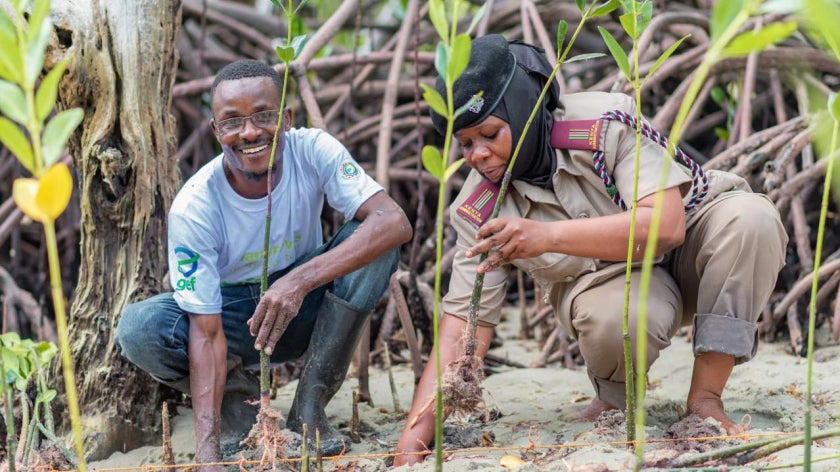
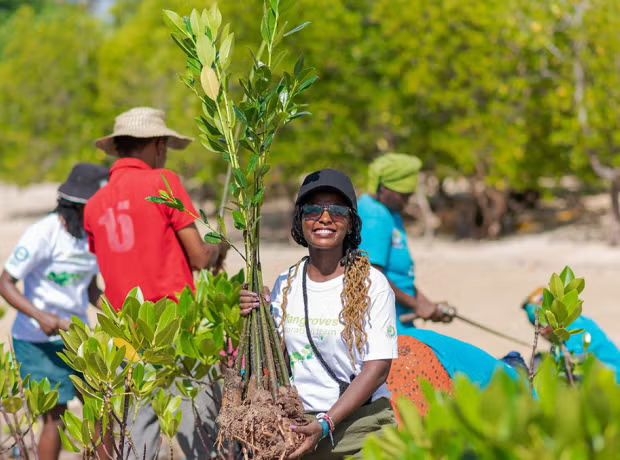
At Nyumba Sita, in Kwale County on Kenya's South Coast, the tide moves through a forest that barely existed a decade ago. Mangrove seedlings planted by hand now stand shoulder-high in the mud, their roots holding back erosion and sheltering the fish that local families depend on. The transformation is the work of the Kenyan Youth Biodiversity Network (KYBN), a youth-led organization that has turned a stretch of degraded coastline into an example of what young people can achieve when given the tools to lead.
Founded in 2017 as Kenya's chapter of the Global Youth Biodiversity Network, the official youth platform of the Convention on Biological Diversity (CBD), KYBN now counts more than 1,200 members and 45 grassroots organizations working across Kenya's marine, wetland, and forest ecosystems. It was instrumental in securing youth participation in the revision of Kenya's National Biodiversity Strategy and Action Plan and in developing country-specific indicators to track young people's contributions to conservation. The network now holds a formal seat on Kenya's National Biodiversity Coordination Mechanism, which oversees the country's progress under the Kunming-Montreal Global Biodiversity Framework.
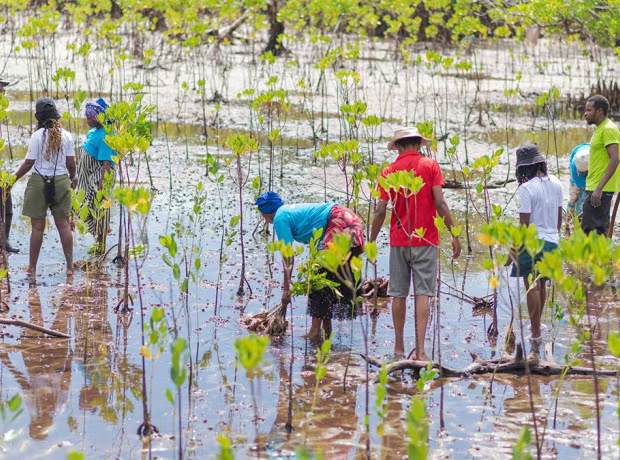
The mangrove program at Nyumba Sita is where that advocacy meets the ground. Working with the local Shangani Amani Self-Help Group, other youth organizations, and county administrators, KYBN has restored more than 15 hectares of degraded mangroves along the Kwale coastline. The work speaks directly to several of the Global Biodiversity Framework's targets: restoring degraded ecosystems, expanding area-based conservation toward the 30x30 goal, buffering coastal communities against climate impacts, and embedding youth and gender-responsive approaches into conservation practice.
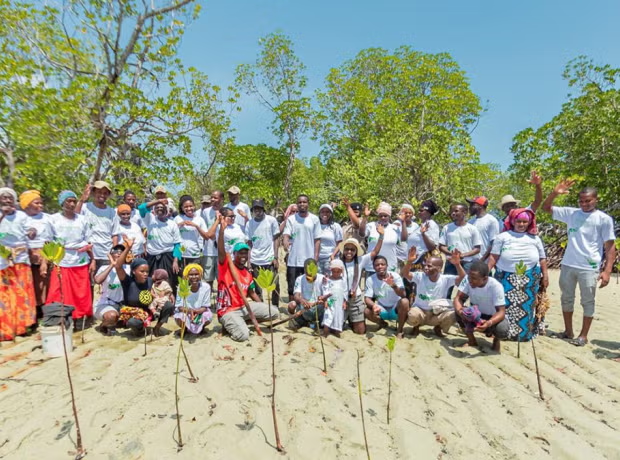
Young people are at the heart of the effort: raising and tending seedlings in nurseries, learning to match mangrove species to the right sites, and planting them along the shore. More than half come from nearby schools and training institutions, including the Ukunda Vocational Training Institute, Pwani University, and the Technical University of Mombasa. They work alongside members of the Shangani Amani Self-Help Group, largely fisherfolk who also farm seaweed.
“Growing mangroves to us has vast benefits, especially in combating manifestations of climate change,” said Kinanasi Jasho Kiyoga, Vice Chair of the Shangani Amani Self-Help Group. “Mangroves make the air better, block coastal storms, and provide nesting grounds for fish, which in turn help our communities.”
KYBN is also sharing what it has learned. Public webinars, exhibitions at the UN Environment Assembly and CBD COP meetings, side events, blogs, and flyers have helped raise awareness of youth-led restoration. The network is now developing a manual on youth-led restoration of blue carbon ecosystems across the Western Indian Ocean, offering practical guidance to other youth-inclusive initiatives seeking to follow its lead.
The results have drawn national and international recognition. In 2023, KYBN was named one of 21 recipients of the Inclusive GEF Assembly Challenge Award, a program that channeled funding directly to community-based groups working with Indigenous Peoples, youth, women, and girls on climate and nature solutions. The $100,000 award announced at the Seventh GEF Assembly in Vancouver allowed KYBN to partner with youth organizations in Somalia, Tanzania, the Democratic Republic of the Congo, and South Africa to restore degraded mangroves and inland wetlands. Kenya's Seventh National Report to the CBD also featured KYBN's work, which by then had reached 10 hectares.
KYBN's ambitions now extend well past its current footprint. With support from the GAN Impact Fund, the network plans to expand restoration around the Diani-Chale National Reserve and build mangrove-based value chains, such as ecotourism and mangrove honey, through training, digital tools, and market partnerships designed to turn conservation into lasting income for local communities. Its target: 200 hectares of restored mangroves by 2030.
For KYBN's National Coordinator, Esther Maina, the numbers tell only part of the story. “KYBN remains a formidable platform for showcasing that young people are equal partners in the shared global vision of halting biodiversity loss by 2050,” she said.
That partnership runs across generations. Bakari Salim, Chief of Msambweni Location, described the restoration work as a form of repair: KYBN, he said, is “helping us [older generations] rectify a problem we created through rampant deforestation of the then-thriving mangrove ecosystems.”
For the families whose livelihoods depend on what grows back, the stakes are immediate. “As fisherpersons, we depend on the ocean directly for livelihoods, and mangroves are essential breeding grounds for fish,” said Ali Nguvu, Chair of the Shangani Amani Self-Help Group. “We appreciate the partnership we have, as it's working towards sustaining our livelihoods.”
Photos credited to KYBN
The results have drawn national and international recognition. In 2023, KYBN was named one of 21 recipients of the Inclusive GEF Assembly Challenge Award, a program that channeled funding directly to community-based groups working with Indigenous Peoples, youth, women, and girls on climate and nature solutions. The $100,000 award announced at the Seventh GEF Assembly in Vancouver allowed KYBN to partner with youth organizations in Somalia, Tanzania, the Democratic Republic of the Congo, and South Africa to restore degraded mangroves and inland wetlands. Kenya's Seventh National Report to the CBD also featured KYBN's work, which by then had reached 10 hectares.
KYBN's ambitions now extend well past its current footprint. With support from the GAN Impact Fund, the network plans to expand restoration around the Diani-Chale National Reserve and build mangrove-based value chains, such as ecotourism and mangrove honey, through training, digital tools, and market partnerships designed to turn conservation into lasting income for local communities. Its target: 200 hectares of restored mangroves by 2030.
For KYBN's National Coordinator, Esther Maina, the numbers tell only part of the story. “KYBN remains a formidable platform for showcasing that young people are equal partners in the shared global vision of halting biodiversity loss by 2050,” she said.
That partnership runs across generations. Bakari Salim, Chief of Msambweni Location, described the restoration work as a form of repair: KYBN, he said, is “helping us [older generations] rectify a problem we created through rampant deforestation of the then-thriving mangrove ecosystems.”
For the families whose livelihoods depend on what grows back, the stakes are immediate. “As fisherpersons, we depend on the ocean directly for livelihoods, and mangroves are essential breeding grounds for fish,” said Ali Nguvu, Chair of the Shangani Amani Self-Help Group. “We appreciate the partnership we have, as it's working towards sustaining our livelihoods.”