
Photo courtesy of / Imagen cortesía de Tania Ukuncham
This story is available in Spanish.
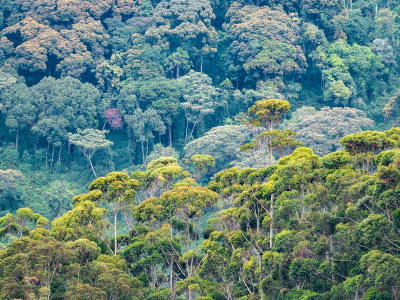
Tania Ukuncham is an advocate for Indigenous women and families in Pastaza, one of the largest and most biodiverse provinces of Ecuador. In a GEF Voices interview, she shared lessons from an effort to connect two Ecuadorian Amazon landscapes, the Putumayo-Aguarico and the Palora-Pastaza, through ecosystem corridors that have also provided support to community schools and farming systems grounded in ancestral knowledge.
What do you do for a living? What are you currently focused on?
I am a Shuar woman from the province of Pastaza. I currently serve as the Director of Women and Family of the Federation of the Shuar Nationality of Pastaza (FENASH-P). In this role, I help defend collective rights, strengthen the leadership of Indigenous women in decision-making, and support youth and our communities.
My work is closely linked to promoting initiatives that advance conservation and sustainable practices that respect the ancestral worldview of the Amazon, particularly within the framework of projects such as the GEF-funded Connectivity Corridors Project, which seeks to maintain the integrity of our territories and the life within them.
What I enjoy most is seeing how women and young people become empowered, actively participate, and regain confidence in their abilities. I am motivated by the knowledge that we are contributing to protecting our territory, strengthening our culture, and building a future with more opportunities for future generations.
How did you get into this line of work?
My path began in my community. From childhood, I grew up learning from my grandparents and elders, who taught me the value of land, respect for nature, and the importance of community life. Over time, I came to understand that this knowledge needed to be strengthened and passed on to new generations. That conviction led me to become involved in organizational and leadership spaces within my community. My participation was furthered through initiatives aimed at strengthening Indigenous economies, where I came to understand the importance of connecting ancestral knowledge with concrete actions for the conservation and sustainable development of our territories.
Is there a GEF-funded project or program that is close to your heart?
More than any specific project, I deeply value the processes driven by the GEF that strengthen communities. In particular, those linked to the Connectivity corridors in two priority landscapes of the Ecuadorian Amazon Region project, because they seek not only to conserve biodiversity, but also to strengthen the language, identity, and intergenerational transmission of the ancestral knowledge of the Shuar people to community schools in the territory, while contributing to the maintenance of traditional production systems, the sustainable use of territory, and agrobiodiversity in the ajas (gardens).
These spaces have allowed Indigenous women and young people to access opportunities for training, exchange, and learning. We have been able to learn from the experiences of other Amazonian territories and understand that we share similar challenges in defending our ecosystems. These are projects that leave lasting marks because they strengthen identity, leadership, and commitment to our territories and cultures.

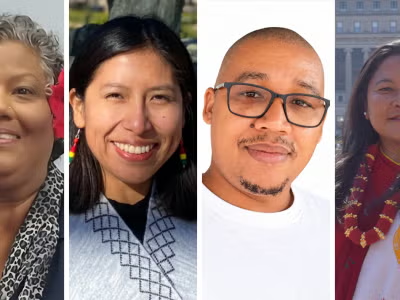
Participatory community workshop of Yapit Shuar women, wise men and women and young people of FENASH-P for the construction of the Shuar aja game "TARAMAK", as an edu-communicational tool aimed at strengthening their intergenerational transmission of knowledge and knowledge from mothers and fathers to children, promoting their recovery, revitalization and continuity over time. Photo courtesy of Tania Ukuncham.
Has anyone you have met through your work made a lasting impact on you?
Yes, I have had the opportunity to meet many Indigenous women who have profoundly shaped my life. Especially the wise women who keep ancestral knowledge alive — our language and the spiritual relationship with the territory. I have also seen how other women leaders, in spaces connected to the connectivity project, inspire through their commitment and collective vision. From all of them, I have learned that leadership is not about holding a position, but about serving with humility, consistency, and responsibility toward the community.
What life lessons has your job taught you?
One of the main lessons has been the importance of listening. True solutions emerge when communities are active participants in processes and their voices are valued. I have also learned that change requires time, patience, and collective effort. In the context of conservation and connectivity corridors, it is essential to bring together different kinds of knowledge — both technical and ancestral. The most sustainable results arise when we work together, respecting our differences and building shared goals.
The state of the global environment is concerning. What gives you hope?
It gives me hope to see young people and women increasingly committed to their territories and to protecting the Amazon. In the processes linked to the GEF project, I have seen how interest grows in learning, strengthening cultural identity, and actively participating in conservation. I am also inspired by the resilience and organization of our communities. Despite threats, we continue to care for our forests, rivers, and ways of life, demonstrating that ancestral knowledge remains key to facing today's challenges.
What advice would you give a young person interested in a career like yours?
I would tell them that they do not have to choose between their identity and their professional future. Both can complement and strengthen each other. It is important to study, learn, and develop new skills — but without losing the connection to community, culture, and territory. I would also tell them to trust their capacity to create change. Young people have a fundamental role to play in building a more just, inclusive, and sustainable future, especially in initiatives like the connectivity corridors that need new voices and new leadership.