DateMay 30 - June 6, 2026
Venue
Samarkand, Uzbekistan

'A healthy planet makes lasting development possible'

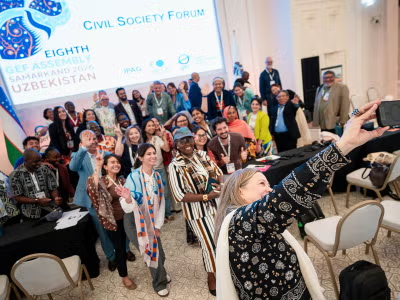
More than 2,000 people across the Global Environment Facility partnership gathered in Uzbekistan with ambition and pragmatism to welcome the $3.9 billion GEF-9 replenishment and share ideas and energy to propel the sprint towards 2030 international goals.

Delegates from around the world joined roundtable discussions, side events, and workshops on priorities for the next four years, including integration, blended finance, whole-of-government and whole-of-society approaches, scaling up support for Least Developed Countries, Small Island Developing States, and Indigenous Peoples and local communities.

Throughout the discussions and high-level proceedings, participants stressed that while environmental challenges are severe and extensive, investments in protecting and restoring nature are helping to build healthier and more resilient economies as well as ecosystems.

“A healthy planet makes lasting development possible,” Interim CEO Claude Gascon told the concluding session of the Eighth GEF Assembly, thanking the Government of Uzbekistan for hosting the flagship gathering and for becoming the multilateral fund’s newest donor to support action in the next four years.

“The last sprint to 2030 has begun. Let us act with urgency. Let us act with purpose. And let us act together — for people, for the planet, and for the many generations to come who will judge what we chose to do with this moment.”

Coverage by IISD ENB

 IISD Earth Negotiations Bulletin provided daily Assembly coverage with summaries and photos.

“What we have seen here is not only a discussion about priorities, but a reminder of what is possible when the world comes together with shared purpose.” The closing remarks by Claude Gascon, Interim CEO and Chairperson of the Global Environment Facility (GEF), marked the conclusion of a busy and successful week of deliberations for the eighth GEF Assembly and the GEF Council meetings.

In the morning, Assembly participants attended roundtables focusing on:

  • how the GEF can increase its resource mobilization by leveraging public official development assistance funding in the future;
  • how the GEF can leverage the conventions and its family of funds to deliver on the 2030 goals;
  • accelerating delivery for environmental outcomes;
  • science, integration, and systems transformation;
  • leaving no one behind: forging partnerships and advancing civil society, Indigenous Peoples and local communities (IPLCs), women, and youth leadership;
  • investing in whole-of-government approaches and policy coherence for scale; and
  • how blended finance and the private sector can bridge the finance gap.

During an afternoon plenary, delegates took note of the reports on credentials and GEF participants as well as the Chair’s report, presented by Co-Chair Shuichi Hosoda, Japan.

In a high-level plenary session, Rosina Bierbaum, Chair, Scientific and Technical Review Panel (STAP), emphasized that over 50% of global gross domestic product depends significantly on nature, saying “we vastly underspend on the life-support systems that underpin our economies, while we extract value from them on a daily basis.” She underscored that investing in nature is not a trade-off with development.

Kenneth Lay, Senior Managing Director, RockCreek, offered a financial market perspective, noting that the global savings pool has vast resources at its disposal. He stressed bridge building to connect asset owners with the environmental community and the need for financial models to incorporate nature degradation as a macroeconomic variable rather than as a footnote. He emphasized that “if we only run this race among ourselves, we are not going to cross the finish line,” and concluded by noting that “the GEF can become the bridge that connects capital markets with the natural environment.”

In a high-level panel discussion moderated by Bierbaum and Lay, Shailendra Mishra, Global Head of Sustainability (Food, Feed and Freight), Olam Agri, suggested the GEF should look at supply chains through an integrated lens. Oliver Withers, Head of Nature Finance, Standard Chartered, discussed how to frame nature as an infrastructure issue, which can unlock private capital for nature-based solutions.

Valerie Hickey, Director for Environment, World Bank Group, urged focusing on blended finance and called for increasing financial resources by looking domestically, including in private banks, national budgets, and uninvested assets. Rachel Kyte, Special Representative for Climate, UK, suggested that framing investment in nature as a security matter could unlock significant investment. Kyte urged for joint public and private investments in education, to build skills that can be applied to environmental and infrastructure transformation.

Joyelle Clarke, Minister of Sustainable Development and Environment, Climate Action and Constituency Empowerment, Saint Kitts and Nevis, called for co-design and co-building of projects with community leadership and recognizing that sustainability and empowerment go hand-in-hand.

Rolph Payet, Executive Secretary, Basel, Rotterdam and Stockholm (BRS) Conventions, urged the GEF to: get environment regulators to talk to each other; think on how to further incorporate circular economy and extended producer responsibility into GEF projects; and consider whether the green technologies advocated today might someday become a source of pollution.

To better promote blue carbon, Alisi Rabukawaqa, Co-Chair, Indigenous Peoples Advisory Group (IPAG), called for the GEF to: consider local stewardship, rights, and benefits; invest in what is already working; and enforce the principle of free, prior, and informed consent.

Among key messages, GEF Interim CEO Gascon stressed: the need to defend public development assistance; promote business models that reward stewardship, not extraction; and ensure the private sector is a true partner in delivering outcomes. In closing, he underscored that “the most powerful transformations occur where people can see themselves in the future being built.”

In his closing statement, eighth GEF Assembly Chair Aziz Abdukhakimov, Advisor to the President of Uzbekistan on Environment, said that the Assembly advanced the global environmental agenda, strengthened the Partnership, and built trust.

Closing the meeting, Gascon stressed the GEF was built on the understanding that no one can meet global environmental challenges alone and brings together countries, conventions, IPLCs, civil society, the private sector, and other stakeholders to deliver global environmental benefits. He urged participants to continue widening participation, deepening ownership, and ensuring those close to the challenges have the space to offer solutions.

Chair Abdukhakimov closed the meeting at 5:12 pm.

Visit IISD ENB for more event coverage, videos, and photos >> 

The world faces interconnected environmental challenges that “know no borders and require collective action at an unprecedented scale.” The opening remarks of Aziz Abdukhakimov, Advisor to the President of Uzbekistan on Environment and Chairman, National Committee on Ecology and Climate Change, upon his election as Chair of the eighth Global Environment Facility (GEF) Assembly, set the stage for the day’s deliberations.

Want to dig deeper into today's talks? Read the full Earth Negotiations Bulletin daily report.

In a high-level opening ceremony, Saida Mirziyoyeva, Head of the Presidential Administration, Uzbekistan, on behalf of President Shavkat Mirziyoyev, welcomed participants to the ancient city of Samarkand, the “bridge between the East and the West.” She described Uzbekistan’s ecological transformation as a new model for development and presented initiatives on: air quality protection; biodiversity conservation and protected areas; waste management; and environmental education, research, and innovation. 

Inger Andersen, Executive Director, UN Environment Programme (UNEP), also speaking on behalf of the GEF agencies, highlighted that the GEF was created from the recognition that environmental challenges transcend national borders and emphasized that the GEF’s science-based solutions have reached communities, protected nature, underwritten resilience, and helped governments deliver their commitments, through local, national, and regional actions.

Speaking for the GEF conventions, Rolph Payet, Executive Secretary, Basel, Rotterdam and Stockholm (BRS) Conventions, underlined the GEF translates convention commitments into reality. He welcomed the new GEF guidance on integrated programming and whole-of-society approach as major steps forward, adding that “non-grant instruments are no longer optional if we are to move into scale.”

GEF Interim CEO Claude Gascon noted the symbolism of convening in Samarkand, the “jewel of the silk road,” where peoples, ideas, and commerce have converged over the centuries to solve the challenges of their times. He urged participants to “seize this moment together with solidarity, courage, and respect for those who came before us, and determination to leave a better world for those who are yet to come.”

In the opening session, delegates, among other things:

  • elected the meeting’s Chair and Vice-Chairs;
  • adopted the agenda and approved the organization of work;
  • took note of the Eighth Overall Performance Study (OPS8) of the GEF, presented by Geeta Batra, Director, GEF Independent Evaluation Office (IEO);
  • took note of the Scientific Technical Advisory Panel’s (STAP) report, presented by STAP Chair Rosina Bierbaum;
  • heard statements by representatives of civil society, Indigenous Peoples, women, and youth; and
  • took note of the reports on the eighth replenishment of the GEF Trust Fund (GEF-8) funding retrospective and on the GEF-9 negotiations.

The remainder of the day was devoted to a series of roundtables that will feed into a final High-level Plenary. The roundtables are convening under nine themes addressing the diverse yet interconnected pillars for delivering GEF-9 ambitions and policy directions, in the final push toward 2030. Each roundtable brought together ministers, heads of international organizations, and representatives of civil society, Indigenous Peoples, and local communities, aiming to present forward-looking solutions to the triple planetary crisis and delve into critical dimensions that collectively shape the global environmental response.

The first day of roundtable discussions focused on:

  • how blended finance and the private sector can bridge the funding gap;
  • accelerating delivery for environmental outcomes;
  • how the GEF can leverage the conventions and its family of funds to deliver on the 2030 goals;
  • leaving no country behind: small island developing states, least developed countries, fragile, and vulnerable countries; and
  • forging partnerships for land and water in Central Asia and beyond.

Visit IISD ENB for more event coverage, videos, and photos >> 

News and Stories

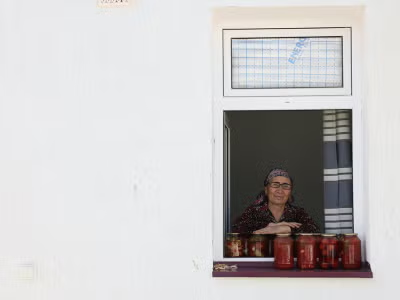
Leading up to the Eighth Assembly, the GEF partnered with the Inter Press Service (IPS) News Agency to feature stories from around the world that highlight the impact of GEF investments. IPS is solely responsible for the editorial content, and it does not necessarily reflect the views of the GEF.

Visit the official Assembly website for a collection of GEF project stories from Uzbekistan and Central Asia.

Summary
Number Title Document Summary Documents
GEF/A.08/Summary Chairs Summary of the Eighth GEF Assembly
Document
Assembly Statements
Number Title Document Summary Documents
GEF/A.08/Statements Eighth GEF Assembly Statements - Countries
Document
Document
Document
Document
Document
Document
Document
Document
Document
Document
Document
Document
Document
Document
Document
Document
Document
Document
Document
Document
Document
Document
Document
Document
Document
Document
Document
Document
Document
Document
Document
Document
Document
Document
Document
Document
Document
Document
Document
Document
Document
Document
Document
Document
Document
Document
Document
Document
Document
Document
Document
Document
Document
Document
Document
Document
Document
Document
Document
Document
Document
Document
Document
Document
Document
Document
Document
Document
Document
Document
Document
Document
Document
Document
Document
GEF/A.08/Statements_Int Eighth GEF Assembly Statements - International Organizations and Conventions
Document
Document
BRS
Document
Document
FAO
Document
Document
Document
Document
Document
WWF